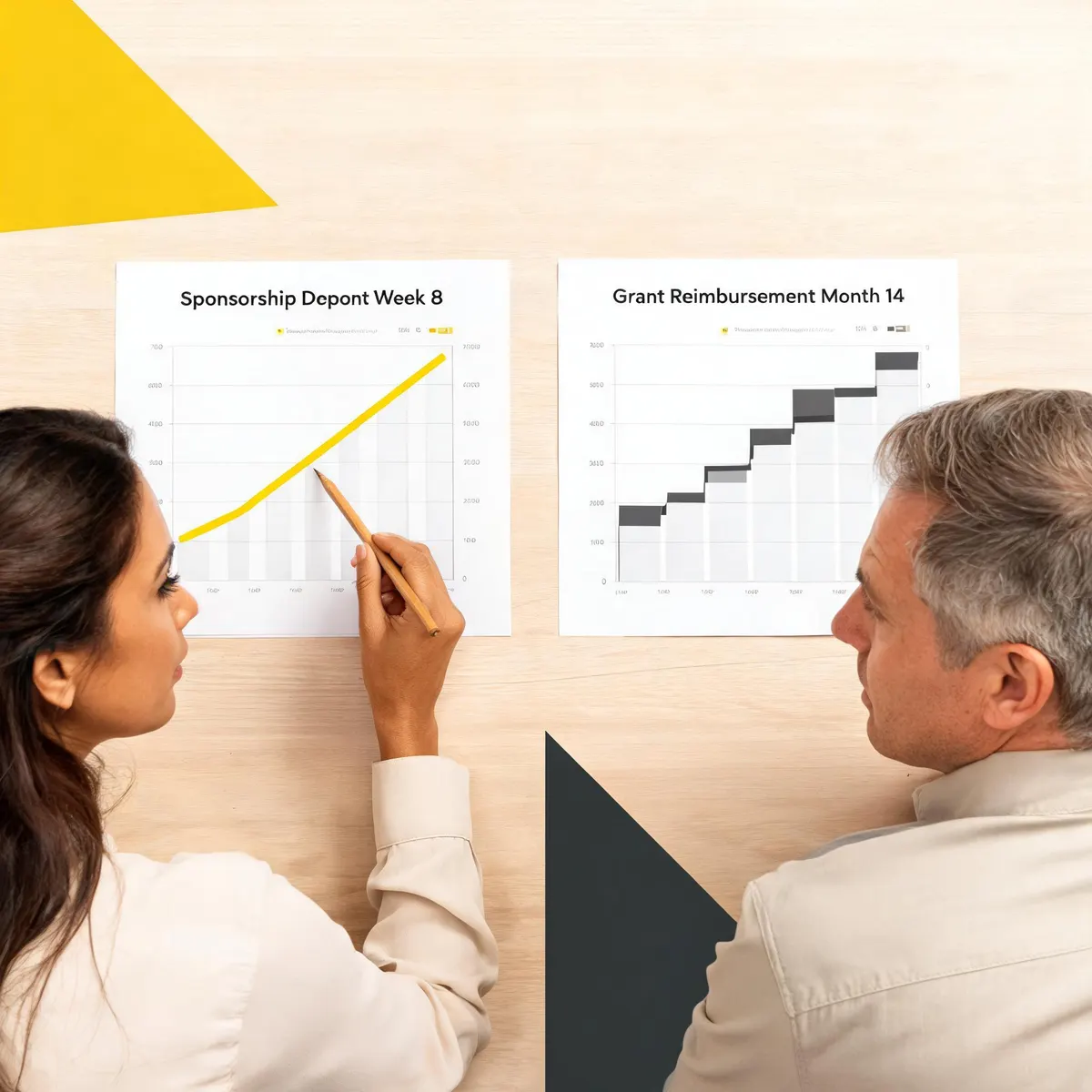

If you run events, you have heard the same advice: pursue grants, diversify revenue, do not rely on one source. That advice is not wrong. But it sidesteps the most important variable for most event organizers — time. Grants and sponsorships both move money from an institution's budget to yours. The similarity ends there. One channel can put a deposit in your account in four to six weeks. The other might respond to your inquiry sometime next fiscal year. Before you invest staff hours in either direction, you need to understand what each channel actually looks like on a calendar.
The Sponsorship Timeline: 30 to 90 Days Is Real
Sponsorship moves fast compared to almost every other institutional funding source — when you have the right proposal and the right prospect. A typical sponsorship cycle for a mid-size event looks like this: week one, prospect identification and outreach; weeks two through three, discovery call and needs alignment; weeks three through five, proposal delivery and internal review by the brand; weeks five through eight, negotiation and contract execution; weeks eight through ten, deposit received.
That is 60 to 90 days from cold outreach to cash in hand — and with a warm prospect or a returning sponsor, it compresses to 30 to 45 days. The speed advantage is structural, not accidental. Sponsorship decisions are made by marketing or partnership budget holders who have quarterly spend targets and relatively fast approval cycles. According to IEG's sponsorship lifecycle framework, the entire process from prospecting to activation is designed to operate within a single planning period.
If you want to understand how Xarify approaches this cycle end-to-end, the Xarify process page walks through each stage from prospect research to contract close.
The Grant Timeline: 6 to 18 Months Is the Floor, Not the Ceiling
Grants operate on foundation calendars, not yours. The realistic timeline from identifying a grant opportunity to receiving funds breaks down like this: weeks one through four, eligibility research and relationship-building with program officers; months one through three, letter of inquiry (LOI) submission and foundation review; months three through five, full proposal invitation and submission; months five through eight, foundation review, site visits, and board approval; months eight through twelve, award notification and grant agreement execution; months twelve through fourteen, first disbursement.
That is twelve to fourteen months from start to first dollar — on a fast cycle. Many federal and state grants run eighteen months or longer. As Candid notes in its grant-readiness guidance, getting from initial proposal to receiving a check typically spans six to nine months at minimum, and that assumes you have an existing relationship with the funder. If you are a new applicant to a foundation, add another quarter for relationship development before you even submit.
The Council on Foundations' grantmaking primer confirms that RFP-to-grant-agreement processes involve multiple review stages, board approval cycles, and legal document execution — none of which moves at your pace.
Step-by-Step: What Each Month Actually Looks Like
The abstract timeline becomes concrete when you map it against a real event date. Say your event is in October and you start planning in January.
Sponsorship path: January — identify prospects and warm up outreach. February — pitch meetings. March — proposals delivered. April — contracts signed, deposits received. May through September — activation planning and fulfillment. You have funding secured by April, five months before your event.
Grant path: January — identify grant opportunities with October-aligned cycles. February — submit LOI. April — invited to submit full proposal (if accepted). June — full proposal due. August — review period ends, board votes. September — award notification. October — grant agreement signed. November — first disbursement. Your event already happened.
This is not a hypothetical edge case. It is the standard experience for event organizers who treat grants and sponsorships as interchangeable. They are not.
When Grants Are Actually the Right Tool
Grants are not inferior funding — they are just the wrong tool for the wrong problem. Grants excel when your program has a mission component that aligns tightly with a funder's priorities, when you have 12-plus months of runway before the funds are needed, and when the restricted-use requirements match your actual budget line items.
Grants also build credibility. A foundation award signals vetting and legitimacy that can help unlock corporate sponsorships. Some sponsors specifically want to see grant backing before they write a check. The two channels are complementary in a well-structured funding stack — they just operate on completely different clocks. If you work with nonprofits building hybrid funding models, the Xarify for nonprofits page covers how to layer sponsorship revenue alongside grant income.
When Sponsorship Is the Right Tool
Sponsorship wins when you need capital in the next 30 to 90 days, when your audience has clear brand-affinity value for a corporate partner, when you can offer tangible exposure and activation rights, and when you want unrestricted revenue that you can deploy however the event demands.
Unrestricted is the word that changes everything. Grant funding almost always comes with spending constraints — you cannot reallocate budget lines, cannot use funds for general operations, cannot easily adjust scope without foundation approval. Sponsorship dollars are yours to direct. That operational flexibility is worth real money to event organizers managing dynamic budgets. The Xarify for events page covers the specific assets and audience data that make event sponsorship packages compelling to brand decision-makers.
The Hybrid Reality: Use Both, But Sequence Them Right
The smartest event funding strategies use both channels — but in the right order and for the right line items. Use sponsorship to cover the near-term cash needs: venue deposits, AV, marketing production, staffing. Use grants to fund the mission-aligned program components that have a 12-month planning horizon: community outreach, education programming, accessibility initiatives.
Do not let grant timelines dictate your event timeline. That is the trap most organizations fall into. They write grant applications in January hoping to fund an August event, then scramble for bridge funding when the grant is delayed or denied. Sponsorship as your primary near-term revenue channel eliminates that risk. According to the Stanford Social Innovation Review's analysis of grant infrastructure, 68 percent of organizations cite time requirements as their primary grant-seeking challenge — a burden that sponsorship pipelines do not carry in the same way.
Bottom Line
If your funding gap is in the next 90 days, sponsorship is your answer. If your funding gap is a program component you are planning for next year, grants belong in that conversation. Confusing the two channels costs you time, staff hours, and in the worst case, your event date. Map your cash needs against your timeline before you decide which door to knock on.
If you are not sure which channel makes sense for your specific situation, the Xarify sponsorship audit is a 30-minute call that gives you a clear answer based on your audience, timeline, and revenue goals.