
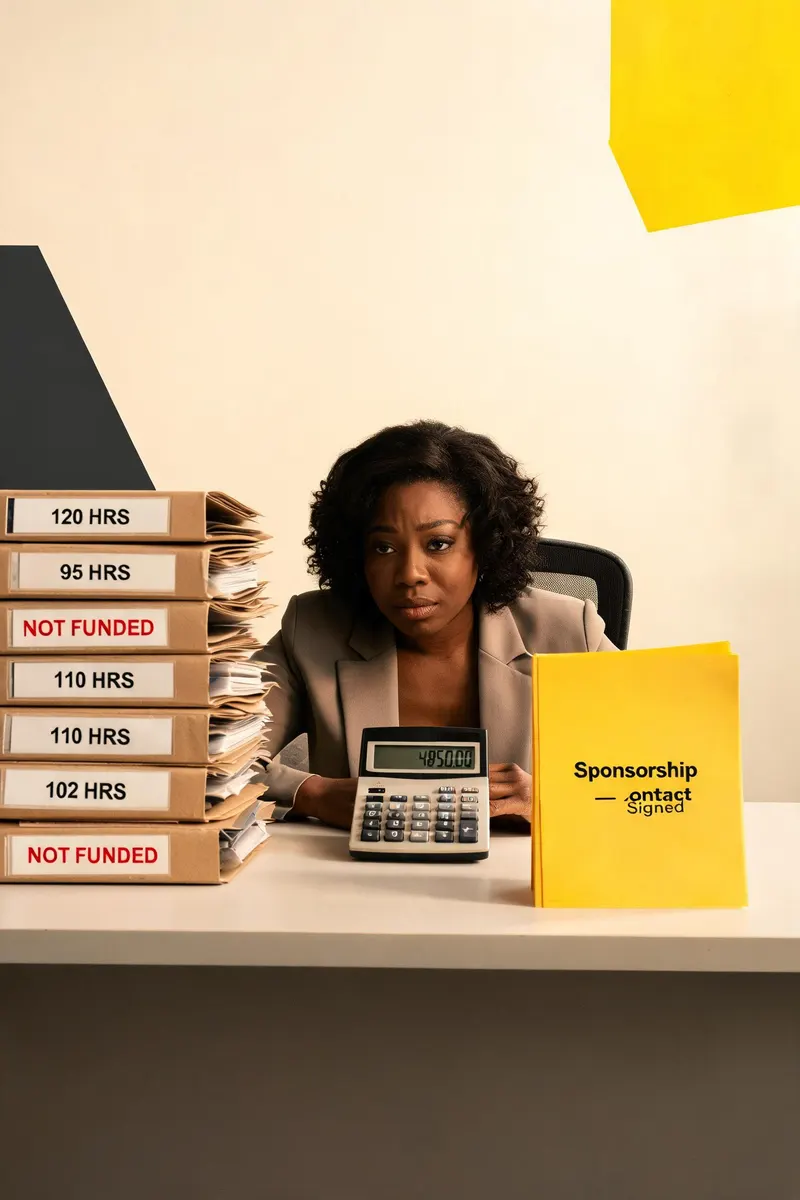
Nobody talks about the cost of a grant you did not win. The foundation does not send you a bill. Your accounting system does not flag the staff hours. But those hours are real money — and when you add them up against your actual win rate, the economics of grant chasing look very different than the fundraising orthodoxy suggests. The grant you pursue this quarter may be one of the most expensive revenue strategies your organization runs, even if you win it. Before you assign another staff member to a proposal, the math is worth doing.
The Hours Nobody Counts
Grant writing is one of those tasks that expands to fill whatever time is available — and then some. A credible proposal to a mid-size private foundation typically requires 40 to 80 hours of staff time for an experienced grant writer who already knows the funder. For a new funder relationship or a complex federal grant, that number climbs to 80 to 200 hours. Those estimates include prospect research, program officer outreach, narrative drafting, budget development, supporting document assembly, internal review cycles, and submission logistics.
The Stanford Social Innovation Review's analysis of grant writing as organizational infrastructure puts it directly: preparing individual proposals requires between two days and four weeks — and that does not include the reporting requirements after the award. Development staff turnover in grant-dependent nonprofits averages 16 to 18 months, in part because the workload is unsustainable. The person writing your grants is likely burning out on a cycle you have not priced into your cost structure.
Your Win Rate Is Probably Not What You Think
Ask a nonprofit leader what their grant win rate is, and most will cite their rate on submitted proposals — the proposals they felt confident enough to actually file. That is not your real win rate. Your real win rate includes every grant you researched and decided not to pursue, every LOI that was not invited to full proposal, and every full proposal that was declined.
When you factor in the full funnel, grant success rates for nonprofits seeking new funder relationships typically land between 10 and 20 percent. Candid's research on foundation giving found that 71 percent of private foundations do not accept unsolicited requests at all — meaning the majority of foundations are not even accessible without a prior relationship. You are not competing against every applicant. You are competing against every qualified applicant to the small subset of foundations that will actually look at your work.
That competitive dynamic means your effective win rate, across all research and outreach effort invested, may be closer to 5 to 10 percent of the time you spend on grant-seeking activities.
The Real Cost Per Dollar Raised
Here is the accounting that most development directors do not run. Take a $25,000 grant. Your grant writer spent 120 hours on research, writing, and submission. Your executive director spent 15 hours on review, program officer calls, and site visits. Your program director spent 20 hours on program documentation and budget review. Your finance director spent 8 hours on budget templates and audit prep. Total: 163 staff hours invested.
At a fully-loaded cost of $40 per hour (modest for most organizations accounting for benefits and overhead), that is $6,520 in staff cost to pursue one grant. If you win it, your net revenue is $25,000 minus $6,520, or $18,480 — and you still have reporting requirements ahead. If you lose it, you spent $6,520 and received nothing. At a 15 percent win rate, your expected value per grant pursuit is about $2,772 in net revenue — before you account for reporting costs on the grants you do win.
Now compare that to a sponsorship deal. A well-run sponsorship proposal process — prospect research, proposal development, pitch meeting, negotiation, contract — typically runs 20 to 40 hours from initial outreach to signed contract. At the same fully-loaded $40/hour cost, that is $800 to $1,600 in staff investment to close a $10,000 to $50,000 deal. Win rates for sponsorship proposals delivered to qualified, pre-researched prospects by experienced practitioners run 25 to 40 percent. The economics are categorically different.
The Opportunity Cost Nobody Budgets
The hours your team spends on grant applications are hours not spent on other revenue activity. That is opportunity cost — and it is invisible in most fundraising performance reviews because you are measuring inputs (applications submitted) rather than outputs (revenue per staff hour invested).
Opportunity cost compounds in grant-heavy organizations. A development team of two full-time staff spending 60 percent of their capacity on grant writing is a team that has 40 percent capacity left for everything else: major donor cultivation, earned revenue, sponsorship development, events. That allocation might make sense if grants are delivering strong returns. But if your grant pipeline is producing net revenue of $2,000 per pursuit, you are locking up your highest-skill staff on your lowest-yield activity.
The Xarify sponsorship ecosystem model is built on the premise that sponsorship prospecting and proposal work, done systematically, generates better revenue-per-staff-hour than most grant programs — especially for organizations with brand-visible audiences and event programming.
When Grant Chasing Is Worth the Cost
This is not an argument against grants. It is an argument for honest accounting. Grants are worth the cost when: the award size is large enough to justify the investment (generally $50,000-plus for a major proposal effort), you have a warm funder relationship that improves your win probability meaningfully, the grant funds a program that would not otherwise be fundable through earned revenue or sponsorship, or your organization has surplus grant-writing capacity that is not displacing other revenue activity.
Multi-year operating grants from major foundations can also fundamentally change your cost-per-dollar calculation — a $300,000 three-year grant amortized over 36 months looks very different than three consecutive one-year $25,000 applications requiring 120 hours each. The problem is that most organizations pursue the latter, not the former, and treat them as equivalent strategies. For nonprofits rethinking this balance, the Xarify for nonprofits page outlines how sponsorship revenue can reduce grant dependency without requiring you to abandon foundation relationships.
How to Do the Accounting Your Organization Is Avoiding
Start with a simple time-tracking exercise. For the next three grant applications your team pursues, log every hour spent by every staff member — research, writing, review, submission, follow-up. Calculate the fully-loaded cost at your organization's average compensation rates. Then compare that to the award size and your historical win rate with that funder type.
Run the same exercise for your last three sponsorship conversations. Hours invested, deal size, close rate. The comparison will tell you more about your fundraising strategy than any benchmarking report. Nonprofit Quarterly's analysis of fundraising ratios has long emphasized that cost-per-dollar-raised is the metric that separates sustainable fundraising programs from expensive ones. Apply that same lens to your grant pipeline.
If you want an outside assessment of how your current mix stacks up, the Xarify sponsorship audit includes a review of where your revenue hours are going and where sponsorship development could shift that ratio in your favor. For context on how sponsorship cycles compare, the IEG sponsorship lifecycle framework outlines the full arc from prospecting to contract close.
Bottom Line
The hidden cost of grant chasing is not the application fee. It is the staff hours, the opportunity cost, and the organizational culture that treats winning a grant as a victory regardless of what it cost to get there. Run the math on your last five grant pursuits. If the cost-per-dollar-raised is higher than your sponsorship channel, you have an allocation problem worth solving. The money is not in the grant — it is in the decision about where your best people spend their best hours. For a practical starting point, explore the Xarify Capture Engine, which is designed to systematize sponsorship prospecting so your team spends fewer hours for better results.